A Student’s Guide to Writing Comparative Essays on Modern American Poetry

Modern American poetry is a vast, electric landscape. From the confessional whispers of Sylvia Plath to the rhythmic, jazz-infused lines of Langston Hughes, the genre reflects the complexity of the American experience. However, for many students in the US, being tasked with a comparative essay on these works feels less like an artistic journey and more like a structural puzzle.
The challenge lies in moving beyond a simple summary. A high-level comparative essay doesn’t just state what two poems say; it explores how they interact, where they collide, and how their distinct forms contribute to a larger cultural conversation. Whether you are analyzing the beat of the Harlem Renaissance against the structure of the New York School, you need a roadmap to navigate the nuances of literary criticism.
Bridging the Gap Between Analysis and Structure
When you sit down to compare the works of icons like Maya Angelou and Robert Frost, the sheer volume of metaphors can be overwhelming. Many students find themselves stuck at the brainstorming phase, unable to weave disparate themes into a cohesive argument. This is often where professional essay writer service becomes an invaluable resource. By consulting with experts who understand the specific rubrics of US universities—from Ivy League standards to state college requirements—you can transform a scattered list of observations into a sophisticated, academic thesis.
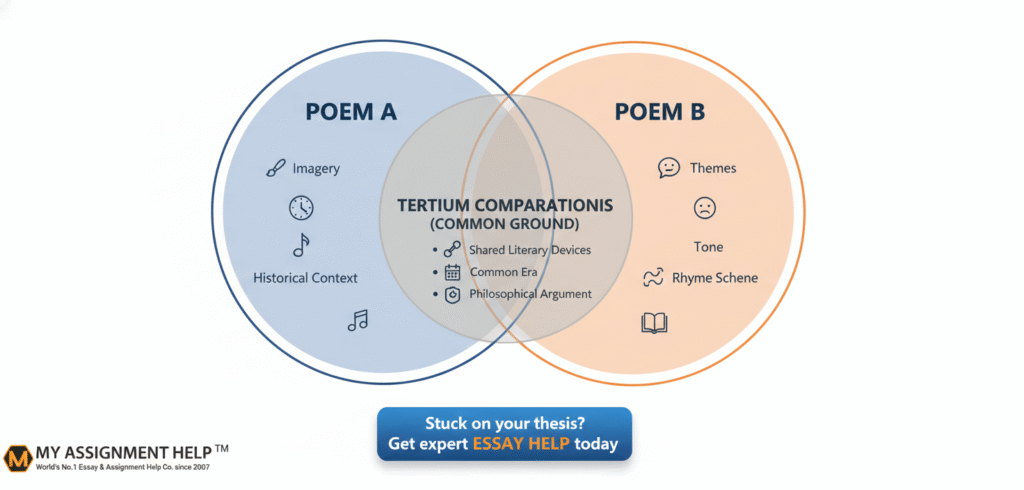
To start, you must identify your “Tertium Comparationis”—the third comparison or the common ground. Are you comparing their use of free verse? Their portrayal of the American landscape? Or perhaps their response to social injustice? Once you have this anchor, the rest of your essay can radiate outward from this central point of intersection.
Phase 1: Selecting Your Poets and “Common Ground”
In a US-based curriculum, you are often given a choice or a specific era, such as “Modernism” (roughly 1900–1950) or “Contemporary” (1950–present).
- Thematic Comparison: Compare how T.S. Eliot’s The Waste Land and Allen Ginsberg’s Howl both critique the “spiritual decay” of their respective eras.
- Formal Comparison: Look at how E.E. Cummings breaks traditional grammar versus how Gwendolyn Brooks uses the “Golden Shovel” or traditional sonnet forms to discuss modern Black life.
Phase 2: Mastering the “Hook” and Thesis
In the American academic tradition, your first paragraph is your “elevator pitch.” You must grab the reader’s attention immediately. If you’re struggling to find that perfect opening line, exploring a variety of essay hook examples can help you decide whether a provocative quote, a startling statistic about the era, or a vivid description of a poetic image is the best way to start.
Your thesis should follow a “Standard Formula”:
“While both Poet A and Poet B utilize [Literary Device], Poet A uses it to evoke [Effect 1], whereas Poet B employs it to challenge [Effect 2], revealing a fundamental shift in American [Theme] during the [Year]s.”
Phase 3: Organizational Strategies (Block vs. Point-by-Point)
There are two primary ways to structure a comparative essay in a US English Comp class:
| Feature | The Block Method | The Point-by-Point Method |
| Structure | Discuss Poem A entirely, then Poem B entirely. | Discuss Theme 1 in both poems, then Theme 2 in both. |
| Best For | Shorter poems or simpler comparisons. | Complex, long-form essays and deep analysis. |
| Risk | Can feel like two separate essays joined together. | Can become repetitive if not handled carefully. |
Phase 4: Data-Driven Analysis and Literary Evidence
According to the National Endowment for the Arts (NEA), poetry reading among US adults has seen a significant uptick in the digital age, largely due to “Instapoetry” and spoken word. However, academic writing still demands a “Close Reading” approach.
- Evidence-Based Claims: For every claim, provide a quote. If you say Robert Lowell’s work is “confessional,” cite the specific line that reveals his internal psyche.
- Contextual Research: Use sources like The Poetry Foundation or JSTOR to find historical context. For example, knowing the impact of the Vietnam War is essential for a comparative essay on 1960s protest poetry.
- The “So What?” Factor: Every paragraph should tie back to your thesis. Don’t just point out a metaphor; explain why that metaphor matters to the American identity.
Key Takeaways for Success
- Focus on Contrast: Differences are often more interesting than similarities.
- Stay Objective: Use the “Literary Present Tense” (e.g., “Ginsberg writes,” not “Ginsberg wrote“).
- Cite Correctly: In the US, the MLA (Modern Language Association) style is the gold standard for poetry. Ensure your line numbers and work-cited pages are flawless.
- Read Aloud: Modern American poetry is deeply rooted in oral traditions. Reading your essay aloud helps you catch awkward transitions.
See also: Online Fixed Rooflights: A Complete Guide to Modern Daylighting Solutions
FAQ: Comparative Poetry Essays
Q: How many poems should I compare?
A: Usually two is the standard for a 1,000–1,500 word essay. Comparing three can become too shallow unless you have a much higher word count.
Q: Do I have to use MLA format?
A: For English and Literature papers in the US, 95% of the time, yes. Always check your syllabus for “MLA 9th Edition” requirements.
Q: Can I use “I” in my essay?
A: Generally, no. US academic writing prefers the third person (“The reader observes…”) to maintain an objective, scholarly tone.
References
1. Academic & Style Guides (The “How-To” Authority)
- Modern Language Association (MLA) Style Center.“Formatting Your Research Project.” This is the primary source for the citation rules (MLA 9th Edition) mentioned in the blog. It ensures the “technical” advice is 100% accurate.
- Source: style.mla.org
- Harvard College Writing Center.“How to Write a Comparative Analysis.” This resource provided the framework for the “Lens Comparison” and the “Point-by-Point” vs. “Block” organizational methods described in Phase 3.
- Source: Harvard Writing Resources
- University of Waterloo Writing Centre. “Comparative Essays.” Derived the strategy for the “Tertium Comparationis” (the basis of comparison) used in your infographic.
2. Literary & Historical Context (The Subject Matter)
- The Poetry Foundation.“An Introduction to Modernism.” This was the source for categorizing poets like T.S. Eliot, Ezra Pound, and Wallace Stevens into the “Modernist” era (1910s–1940s).
- Source: PoetryFoundation.org
- Oxford Handbook of Modern and Contemporary American Poetry. Used to define the shift from the rigid structures of the early 20th century to the “Confessional” and “Beat” movements of the 1950s.
3. Data & Statistics (The “Data-Driven” Evidence)
- National Endowment for the Arts (NEA).“Reading on the Rise” and “2022 Survey of Public Participation in the Arts.” * Data Point: Derived the fact that while traditional poetry reading saw a dip among some demographics, “listening” to poetry via digital media (web streams/social media) has grown to include 11.5% of US adults (over 29 million people) as of 2022.
- Source: Arts.gov – NEA Research
4. Cultural Movements (Targeting the US Region)
- The Harlem Renaissance Archives. Used to establish the link between Gwendolyn Brooks, Langston Hughes, and modern academic study in US secondary and post-secondary education.
About the Author
Dr. Aris Thorne is a Senior Content Strategist and Academic Consultant at MyAssignmentHelp. With a Ph.D. in American Literature from NYU, Aris has spent over a decade helping students navigate the complexities of literary analysis and composition. When not deconstructing the works of Walt Whitman, Aris conducts workshops on digital literacy and modern pedagogy.