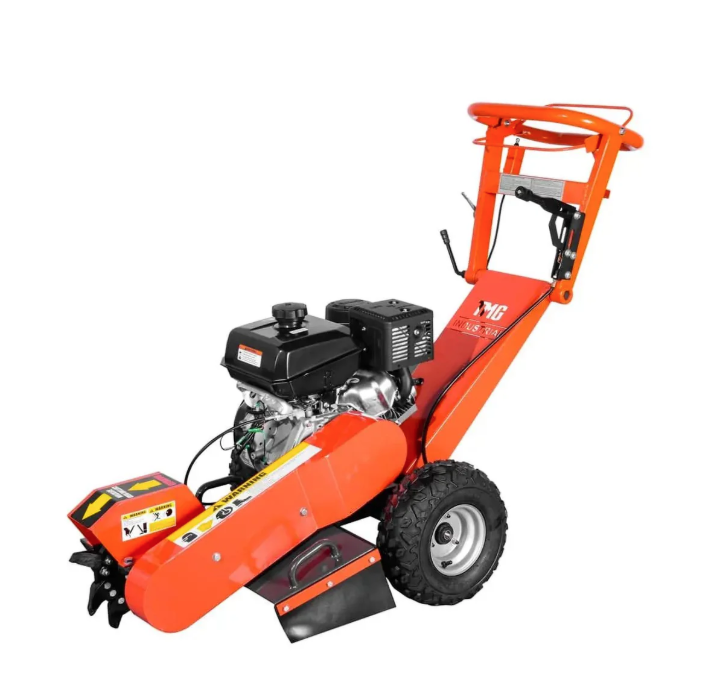
How a Walk-Behind Stump Grinder Chips a Tree Stump Away Below Ground

A stump is the part of land clearing that gets left behind.
On Australian properties, felling a tree is only half the job. The stump stays in the ground, and it is more than an eyesore.
A buried stump sprouts regrowth, harbours termites that then move toward buildings, and blocks any plan to mow, plant, or build over the spot. Burning it out is slow and risky in a country that watches its fire danger closely.
A stump grinder removes the problem mechanically instead, grinding the wood down below ground level so the land can be used again. Understanding how it works shows why it succeeds where an axe or a fire does not.
Grinding is Thousands of Small Cuts, Not One Big One
The working part is a steel wheel studded with hardened carbide teeth, spun at speed by the engine. The wheel does not chop; it chips.
Each tooth that sweeps past the stump bites off only a sliver of wood. It is the sheer number of bites, thousands every minute, that turns a solid stump into a pile of chips.
Think of it as a powered rasp rather than an axe. No single cut is large, so the machine never has to overpower the whole stump at once, which is exactly why a compact unit can defeat a stump far bigger than itself.
See also: Stylish Home Environment and Interior Care Guide for Better Living
Why Going Below Grade is the Whole Point
Cutting a stump off flush with the ground leaves the root crown alive and the timber still in the soil. The roots can reshoot, and the buried wood still feeds termites.
A stump grinder is built to work past that line. The operator lowers the wheel below the surface and grinds the crown and upper roots away, so nothing is left to sprout or rot in place.
That is the difference between hiding a stump and removing it. The ground is left as fillable soil and chips rather than a stubborn lump.
Engine, Control and Safe Operation
A petrol engine matters because stumps sit where mains power does not, out in paddocks and back blocks. The walk-behind stump grinder lets one person wheel the machine to the stump and work it by hand.
The technique is patient rather than forceful. The operator swings the wheel across the stump in shallow passes, letting the teeth do the cutting, and lowers it gradually rather than forcing it deep in one go.
Grinding throws wood chips and the occasional stone at speed, so safe operation is not optional.
- Keep people and pets well clear of the discharge zone.
- Wear eye and ear protection throughout.
- Clear loose rocks from around the stump before starting.
- Stop the engine and let the wheel halt before inspecting the teeth.
Where It Earns Its Place, and Where It Does Not
The strengths follow from the method. A stump grinder clears a stump cleanly, works below ground where it counts, needs no fire or chemicals, and reclaims the spot for replanting or building.
The limits follow too. It is built for stumps, not whole-tree removal, the carbide teeth wear and must be kept sharp, and deep or very large root systems still take time and repeat passes.
Read against the job, the trade is plain. A stump grinder gives up brute speed in favour of patient, thorough removal, which on most Australian blocks is exactly what turns a cleared tree into usable ground again.